

I was conducting a Google search to better understand the situation of women in the labor market in Brazil and came across the following situation:
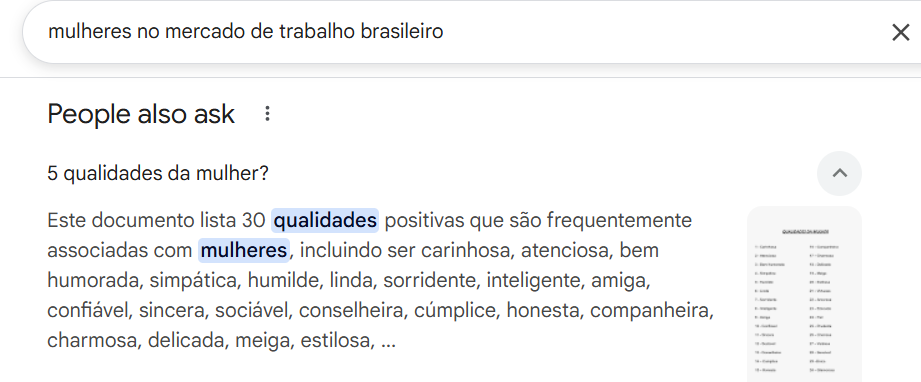
This shows that women are still expected to have characteristics associated with the home, motherhood, and family roles. But what about professional qualities? The fact is that we still face many prejudices in the labor market, especially Black women.
An overview of the labor market in Brazil
The comparison between employed women and men or those in managerial positions still shows a significant gap. There are also other factors that affect women’s work journeys, whether they are already employed or searching for a job.
Data from the IBGE (Brazilian Institute of Geography and Statistics) in 2022 show that only 53% of women participated in the workforce, compared to 73.2% of men. Among the 52% of employed Black women, 43% held informal jobs.
The numbers are even lower when it comes to leadership positions: in 2022, only 39% of leadership roles were held by women, while 60% were occupied by men. Black women held just 0.4% of management positions among the 500 largest companies in Brazil (Instituto Ethos, 2020).
Barriers faced by women professionals
Beyond employment rates, women must also deal with the double burden that includes domestic work. Taught from childhood to take care of the household, women tend to value and take on domestic responsibilities more than men. According to IBGE, women spend twice as much time on household work compared to men.
Contradictions
As a result, domestic work becomes a barrier that prevents women from dedicating more time to their careers and education. Even though 21% of women complete higher education compared to 16% of men, their salaries are usually 21% lower than those of men.
Prejudice
Job interviews can be a turning point. Lina Nakata, a labor market specialist and creator of the research project “Lugares Incríveis para Trabalhar” (Amazing Places to Work), explains that while women are often required to demonstrate more skills in order to advance in a role, men are encouraged to grow and adapt to new challenges.
For Black women, the challenges are even greater. According to a study conducted by Carreira Preta, 68% of respondents reported being mistaken for cleaning staff at some point in their careers. Seventy percent said they had to justify their hair choices. Another point of concern is the change in recruiters’ attitudes when they realize the candidate is Black or when she talks about where she lives.
Women who have children also face prejudice. According to Catho, 60% of them are unemployed and only 15% hold leadership roles. Meanwhile, 60% occupy operational positions. Wage disparity also appears in this context: 38% of respondents said they earn lower salaries than colleagues in similar roles and believe this is due to motherhood.
Possible paths forward
The Equal Pay Law, established in 2023, is not enough to ensure better quality of life for women. As discussed in this text, disparities still exist, and this legislation only applies to workers formally employed under Brazil’s CLT labor regime. In Brazil, around 47% of the female workforce is in informal employment (IBGE).
The core of the problem lies in structural issues, including deeply rooted sexism and racism in our society. As human beings, we need to reassess the concepts and prejudices we carry—often without even realizing it.
It is necessary to go beyond promises and move toward action. Many women have already been creating projects to encourage one another to enter and grow in the labor market. However, this alone is not enough. We also need stronger government support in education and tools that help women develop their careers. Hiring companies must also open their eyes and see female candidates as dedicated professionals, not merely as “women who want to work.”
Furthermore, for the labor market to become more inclusive, diversity must also be present when designing strategies aimed at inclusion. People who experience the realities faced by women understand where the pain points are and can help change this scenario. And those pain points are different, shaped by each woman’s life experiences.