
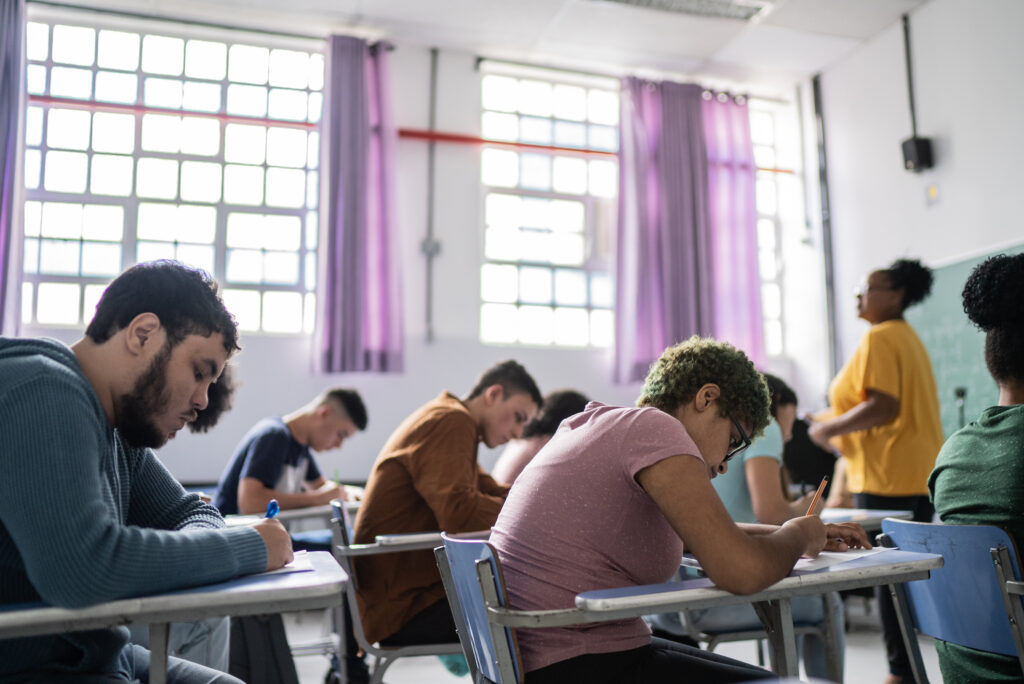
Every year, millions of Brazilians take the Exame Nacional do Ensino Médio (ENEM, Brazil’s National High School Exam), one of the country’s main routes into higher education. Originally introduced to assess students’ performance at the end of secondary education, the exam is now also used for admission to public and private universities through government programmes. Its results are also accepted by higher education institutions in Portugal.
The ENEM attracts both young people completing secondary school and adults looking to return to education or pursue new career opportunities. According to Brazil’s Ministry of Education (MEC), via the National Institute for Educational Studies and Research (Inep), the exam recorded more than five million confirmed registrations in 2026.
As the exam approaches, interest in preparation, university admissions and academic choices increase. For educational institutions and education technology companies (EdTechs), this time of year presents communication opportunities, provided that campaigns address students’ questions and take into account the particularities of the Brazilian market.
The ENEM and opportunities for the education sector
According to Google Trends data, reported by CNN Brasil in August 2026, November and October, respectively, recorded the highest search interest for the term “Enem” over the 12-month period analysed. Brazil’s Northeast region showed a level of interest 50% higher than the national average.
This interest is also reflected in demand for academic support services. Research by GetNinjas highlighted a 24.67% increase in requests for private tutoring and additional academic support on its platform between September and November 2025, compared with the beginning of the year’s second semester.
For EdTechs, this timeline offers opportunities for different approaches, from study materials throughout the year and revision resources closer to the exam to guidance on results, cut-off scores and university admissions afterwards. Planning these activities in advance is important, as content, expert interviews and partnerships with creators all need to be prepared before interest peaks.
SEO and content that answer students’ questions
The TIC Educação 2024 survey, published by Cetic.br, found that among primary and secondary school students who use the internet, 86% searched online for information about subjects or assignments they had difficulty understanding, 78% used digital tech to practise learning activities, and 74% watched video lessons or tutorials.
A Brazil-specific SEO strategy can identify the terms students use and organise content around their questions. An essay-writing guide, for example, can remain useful throughout the year, while pages covering registrations, exam schedules and results need to be updated for each edition.
Public relations and influencer marketing: data, experts and local audiences
Education platforms can also turn usage data, where available and responsibly analysed, into stories for the press. Information on frequently asked questions, demand for particular subjects or performance in mock exams can provide a basis for news articles and interviews with experts. A public relations strategy helps identify what is newsworthy, put findings into context and prepare spokespeople to explain them without drawing conclusions that go beyond what the data shows.
Social media offers another way to reach students. According to TikTok, the term “Enem” was searched more than 7.5 million times on the platform between 28th October and 17th November 2024. From January to October 2025, videos about the exam generated 3.8 billion views in Brazil. The company also reported a 6.5-fold increase in views and a 5.7-fold increase in posts related to the topic.
In this environment, influencer marketing campaigns involving teachers and specialist content creators can deliver information about studying and exam preparation to audiences who already follow these professionals. Partners should be selected based on their subject knowledge, audience profile and content quality, rather than reach alone. For international brands, working with local creators also helps to avoid messaging that feels disconnected from the realities of Brazilian students.
Communications that reflect the Brazilian calendar
Campaigns around the ENEM need not be limited to exam days. By combining search-friendly content, information that is of interest to the press and partnerships with creators, EdTechs can take part in a range of conversations throughout the year. The starting point is the same across all these activities: understanding what questions Brazilian audiences are asking and providing clear, verifiable answers suited to each stage.